
Last time, we sat down on the swing together. Trust, safety, rapport, connection, respect- the High Five that makes the whole thing possible.
Now the client’s sitting next to you. This is where a lot of coaches get stuck before the session even really starts.
You ask, what would you like to focus on today.
And the client says, I don’t know.
Most coaches hear that as one thing, this person needs help finding a topic. And then the coach does the natural thing, starts offering topics, starts guiding, starts filling the silence.
I want to offer you a different way to hold this. “I don’t know” can mean at least seven things, and every single one calls for something different from you.
It can mean, I need help finding where to start.
It can mean, I’m still deciding if my topic is appropriate for this space.
It can mean, I’m wondering if you can handle what I have to say.
It can mean, I’m still building trust before I go there.
It can mean, I know exactly what I want, I’m just looking for the actions to take.
It can mean, I’m frustrated, and right now I just want to say it out loud.
It can mean I’m still learning what coaching looks like, so I’m figuring out what I’m allowed to bring here.
Seven different sentences, all wearing the same three words.
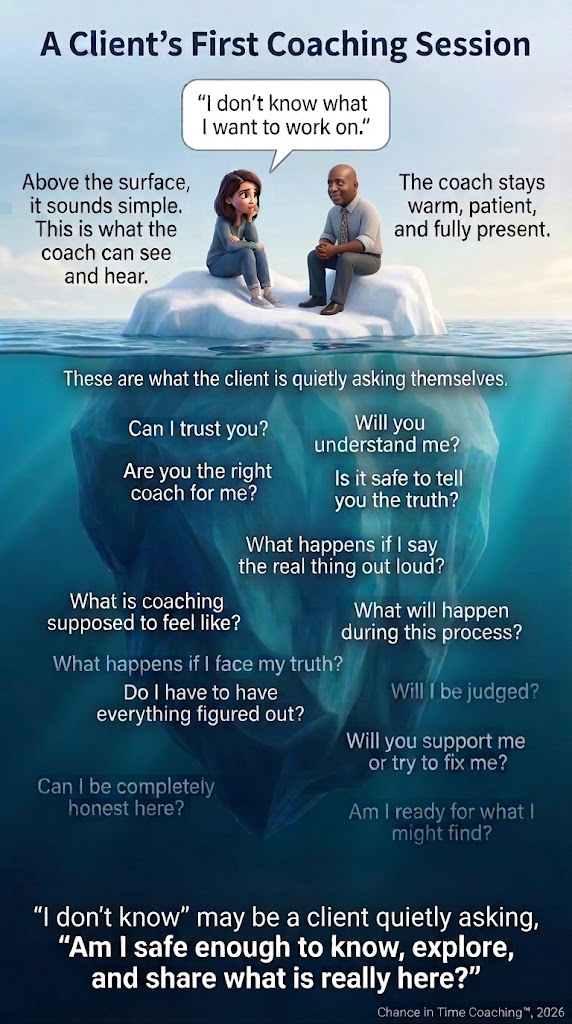
I think about a client. First session, I ask what they want to work on. They say, I don’t know, honestly, and they shrug. An easy read would have been to pick something for them. Instead, I asked, is it that you’re looking for where to start, or is it more that you’re still deciding how much you want to bring here today? They got quiet for a second and said, honestly, the second one. That one sentence told me everything I needed for the rest of that session.
There’s a picture that’s helped me think about this for years: the iceberg.
Above the water, you’ve got behavior. What the client says out loud. I don’t know. I want to brainstorm. I just need to vent. That’s real, and it’s also just the tip of what’s actually going on.
Below the water, you’ve got beliefs. What the client believes about this moment, about coaching, about themselves right now. I should already know this. This might be a lot to bring here. I’m still figuring out what I’m allowed to just talk about without a plan.
And deeper still, values and thought patterns. How this particular person has learned to trust, how they’ve learned to ask for help, whether structure feels safe to them or feels like pressure. This is the layer that takes the longest to see, and it’s usually the layer steering the boat.
Nobody can see all of that in one session. What you can do is listen for it, name what you’re noticing, and let the client tell you if you’re close.
So here’s the actual skill, and I want to be precise, because it’s easy to get sideways on.
You are going to form a read. That’s what listening well produces. You’ll hear something below the surface, and a guess will form in your mind about what this person actually needs right now.
The skill is what you do with that guess. Rather than acting on it silently, bring it back up to the surface and check it. Something like, it sounds like you already know what you want to do, and you’re looking for the next step. Does that sound right? Or, I’m noticing you keep circling back to how this is landing for me; would it help to just say what’s on your mind first, before we shape anything?
That question is the whole move. Listen below the surface, name what you heard as a guess, and let the client confirm, correct, or redirect. Every time.
This is also a great moment to just ask directly, and I want to give you permission to do that, because sometimes coaches think a good question always has to be indirect.
You can simply say, how would you like to use our time today. Is this more about brainstorming together, or are you looking to build an action plan, or do you need space to think something through out loud, or honestly, do you just need to vent for a minute, or is there something you’d find useful to learn more about?
That’s the Focus Menu. Five doors, and the client picks which one they’re walking through, or tells you it’s actually a mix, which happens plenty.
Handing someone a menu changes the whole dynamic. Instead of you guessing what kind of session this is, they get to choose. And choosing is powerful on its own, before the real work even starts.
The next time someone says, I don’t know, try meeting it with curiosity. Ask yourself what kind of not knowing this might be. Listen below the surface, name your guess out loud, and let them confirm it.
Listen. Name it. Let them choose.
Next time, we take everything we’ve built here- the High Five, the listening, the Focus Menu- and put it into motion. Five ways a session can move: Collaboration, Action, Reflection, Empathy, Education, and how they flow into each other, with the client guiding the direction.
See you there.