
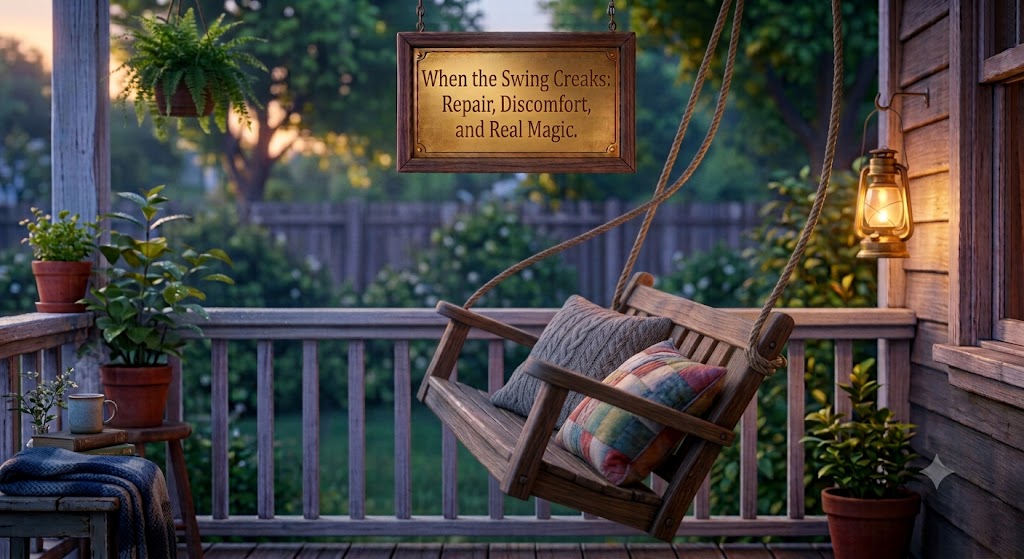
Every swing creaks sometimes. Wood settles, chains shift, weight moves in a way that makes a sound you notice. That’s what happens when something real is holding real weight.
Coaching relationships creak too. This module is about those moments, and what to do when they show up.
When the Start Feels Shaky
Some clients arrive already braced. Maybe they’ve tried coaching before and it felt underwhelming. Maybe they’re uncertain whether this time will be different. You’ll hear it in something like, I’ve done this before, and I’m not sure it’s going to work this time.
Here’s the temptation in that moment: to defend the process, to explain why this time will be different, to convince them. I want to offer you something else instead.
Winning them over is not it. Extending one piece of the High Five, clearly and simply, and letting the rest build from there. Something like that makes sense, and we can simply see how this first conversation feels; no need to decide today whether this works. That’s trust, offered without a sales pitch behind it.
The Small Breach
Here’s a scenario worth sitting with. You show up three minutes late. The client says it’s fine. You can feel something lingering underneath that.
This is a real test of the container, and honestly, it’s a gift. Small breaches like this are where trust either gets stronger or quietly erodes, and it’s almost always your choice which one happens.
The move here is simple and a little uncomfortable: name it before they have to. Something like, I want to acknowledge I was a few minutes late, and I want to name that rather than just move past it. Thank you for your patience. You’re keeping it in proportion. You’re also honoring that it happened. That honoring is what rebuilds trust faster than any apology alone would.
The Withheld Moment
I think about a client who had a real insight mid-session; you could feel it land, and then within a breath, they changed the subject to something lighter. I could feel the magic hovering right there, and also feel it drifting away.
I had a choice in that moment. Follow them to the new topic, or gently name what I sensed. I chose the second one. I said, I noticed something shifted for you a second ago; we can stay with that if you want, or we can go where you just went; either is completely fine. They paused, and then said, can we go back for a second.
That’s the whole practice. You let the client lead whether to stay or move on, and you offer them the option to return, gently, and let them choose. Same skill from every module before this one; it just takes more care to use when the moment feels delicate.
Magic Doesn’t Always Feel Comfortable
I want to offer you something important, because it might be the most counterintuitive part of this whole program.
Sometimes real magic shows up in a session that feels hard, not just the comfortable ones.
I had a client once, deep in a session, working toward something that stretched them well beyond their comfort zone. They looked at me and said, ” This is extremely uncomfortable; it’s something I want, and I’m struggling to like you right now. Half joking. Also completely serious.
That was real magic. They stayed in the container even while they wrestled with liking me in that moment. The high five was strong enough to hold real discomfort, exactly what it’s built for.
What Grows Over Time
Here’s one more thing worth naming before we close this program out. Some sessions feel quiet, no breakthrough, no tears, nothing you’d immediately point to and call magic.
Those sessions still matter. Trust can deepen there. Safety can get reinforced there. And often, it’s the very next session where everything you quietly built shows up.
That’s the part of this work that keeps unfolding the longer you do it, session after session; the relationship itself keeps growing, the same swing holding more and more over time. That’s worth paying attention to as its own kind of practice, the relationship you’re building across every conversation, not just what happens in any single one.
Your Invitation
So here’s something I want to offer you as we close this out. Think about your own high five. Where has your magic actually shown up? The quiet moments, more than the loud ones. When did you last feel it?
That’s where this whole program started, and it’s where I want to leave you too. A relationship to keep building, one honest hand at a time.
Thank you for sitting on this swing with me through all four of these conversations. It’s still moving. Come back to it anytime.